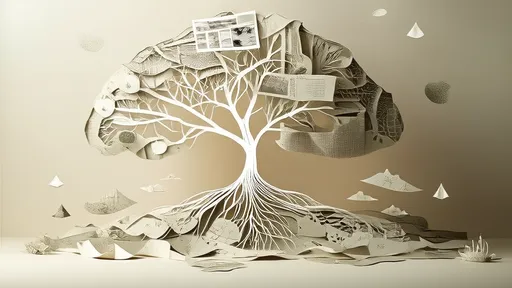
In the quiet corners of contemporary art galleries, a subtle revolution is unfolding. Paper, that most humble and ancient of materials, is undergoing a profound transformation, emerging as a powerful medium for exploring ecological consciousness and memory. The exhibition Ecological Care and Memory Reconstruction: The Rich Conceptual Possibilities of Contemporary Paper Art presents a compelling narrative that transcends traditional craft, positioning paper art at the forefront of conceptual discourse.
The journey begins with the material itself. Artists are no longer treating paper as a mere surface for drawing or printing. Instead, they are engaging with its very essence—its fibrous structure, its history as pulped wood or recycled material, its vulnerability to time and elements. This deep material engagement becomes a form of ecological meditation. One artist creates intricate, large-scale installations from handmade paper embedded with seeds from endangered local flora. Over the course of the exhibition, these seeds may sprout, transforming the artwork into a living ecosystem that comments on regeneration and fragility simultaneously.
Another powerful theme explored is that of memory—not as a static record, but as something fluid, layered, and often fragmented. Artists use paper's inherent qualities to manifest this concept. Through techniques of layering, tearing, and translucent overlapping, they create works that resemble palimpsests, where past and present coexist. One particularly moving series uses paper made from shredded personal documents—letters, diaries, legal papers—that are then reformed into new, abstract landscapes. This process of destruction and recreation becomes a metaphor for how we process and reconstruct our own memories, never fully erasing the past but integrating it into new forms.
The ecological dimension extends beyond material choice to encompass the entire lifecycle of the artwork. Several artists in the exhibition have developed works that are designed to change, decay, or be repurposed after the show concludes. This challenges the conventional art market's demand for permanence and instead embraces impermanence as an ecological virtue. One installation features paper sculptures that visitors are encouraged to gently mist with water throughout the exhibition. The gradual warping and eventual dissolution of the forms becomes part of the artwork's statement about the transient nature of all things.
Memory reconstruction takes on collective dimensions in works that incorporate community participation. In one ongoing project, the artist collects paper ephemera from specific neighborhoods slated for redevelopment—old theater tickets, grocery lists, children's drawings found in abandoned homes. These fragments are pulped and reformed into large-scale maps that preserve the texture of community memory even as the physical spaces transform. The resulting artworks serve as tactile archives, holding the emotional residue of places that no longer exist in their original form.
The conceptual richness of contemporary paper art lies in its ability to operate on multiple registers simultaneously. A single piece might function as an environmental statement about deforestation, a personal meditation on loss, and a formal investigation of light and shadow. This multiplicity resists easy categorization, which is precisely what makes the work so compelling. The material's accessibility—everyone has held paper—creates an immediate point of connection, while the conceptual depth invites prolonged engagement and reflection.
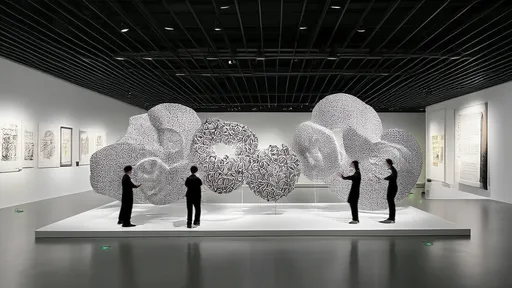
Several artists push paper to its physical limits, creating works that challenge our perception of the material's strength and durability. Suspended installations featuring paper chains that appear too delicate to support their own weight, yet do, become metaphors for resilience. Other artists employ paper in ways that reference industrial materials—creating corrugated cardboard structures that resemble concrete architecture or paper pulp formations that mimic geological strata. These transformations speak to paper's incredible versatility and its ability to stand in for other materials while maintaining its essential paperness.
The intersection of digital and analog processes represents another frontier in contemporary paper art. Some artists begin with digital scans of natural forms—leaf veins, water ripples, bark textures—which are then laser-cut into paper, creating works that exist in the liminal space between technological precision and organic inspiration. Others use paper as a medium to critique digital culture, creating intricate pop-up books that unpack the complexities of social media algorithms or data privacy concerns, thus bringing critical discourse back into the tactile realm.
What becomes clear throughout the exhibition is that paper art is no longer confined to the domain of craft or decorative art. It has firmly established itself as a serious conceptual practice capable of addressing the most pressing issues of our time. The material's historical associations with documentation, communication, and ephemerality provide a rich foundation from which to explore contemporary concerns about environmental crisis, the preservation of memory in an age of digital overload, and the search for authentic human connection.
The exhibition successfully demonstrates that ecological care and memory reconstruction are not separate concerns but deeply intertwined. The way we treat our environment reflects how we value our past, and how we remember shapes our future actions toward the planet. Paper, in its beautiful simplicity, becomes the perfect medium to explore this complex relationship—it comes from trees, carries our stories, and eventually returns to the earth, completing a cycle that mirrors the very ecological and mnemonic processes the artists seek to illuminate.
As visitors move through the galleries, they encounter works that demand not just visual appreciation but a more holistic sensory engagement. The subtle rustle of paper in a gently moving installation, the faint scent of pulp and plant matter, the invitation to touch certain works—all these elements create an immersive experience that stands in stark contrast to the sterile white cube model of contemporary art presentation. This embodied engagement reinforces the exhibition's central themes, reminding us that ecology and memory are not abstract concepts but lived experiences.
The future of paper art appears boundless, with artists continuing to discover new techniques and conceptual applications. Some are experimenting with bioplastics derived from paper waste, creating works that bridge traditional craft and material science. Others are developing community-based projects that use papermaking as a therapeutic practice for processing collective trauma. The medium's adaptability ensures its continued relevance, offering endless possibilities for artists committed to exploring the relationship between human creativity and planetary responsibility.
What makes this exhibition particularly timely is its quiet insistence on slowness in an era of acceleration. The labor-intensive processes of papermaking—soaking, pulping, pressing, drying—require patience and presence. The artworks themselves often reveal their complexity gradually, rewarding sustained looking. In this, they offer a counterpoint to the rapid consumption of images that characterizes much of contemporary visual culture. They ask us to slow down, to consider the material origins of what we see, and to reflect on what we choose to preserve and what we allow to transform.
Ultimately, Ecological Care and Memory Reconstruction presents paper not as a nostalgic relic of pre-digital times, but as a vital, dynamic medium for critical engagement with our present moment. The exhibition makes a compelling case for the continued importance of tactile, material-based practices in an increasingly virtual world. It reminds us that some truths are better understood through the hands than through the screen, and that the simplest materials can sometimes carry the most profound messages about who we are, what we remember, and how we care for the world we inhabit.
By /Oct 24, 2025
By /Oct 24, 2025
By /Oct 24, 2025

By Jessica Lee/Oct 24, 2025
By Emma Thompson/Oct 24, 2025
By /Oct 24, 2025
By James Moore/Oct 24, 2025
By /Oct 24, 2025
By /Oct 24, 2025
By /Oct 24, 2025
By /Oct 24, 2025
By /Oct 24, 2025

By /Oct 24, 2025
By Sarah Davis/Oct 24, 2025
By /Oct 24, 2025

By /Oct 24, 2025
By /Oct 24, 2025
By /Oct 24, 2025
By /Oct 24, 2025
By /Oct 24, 2025